
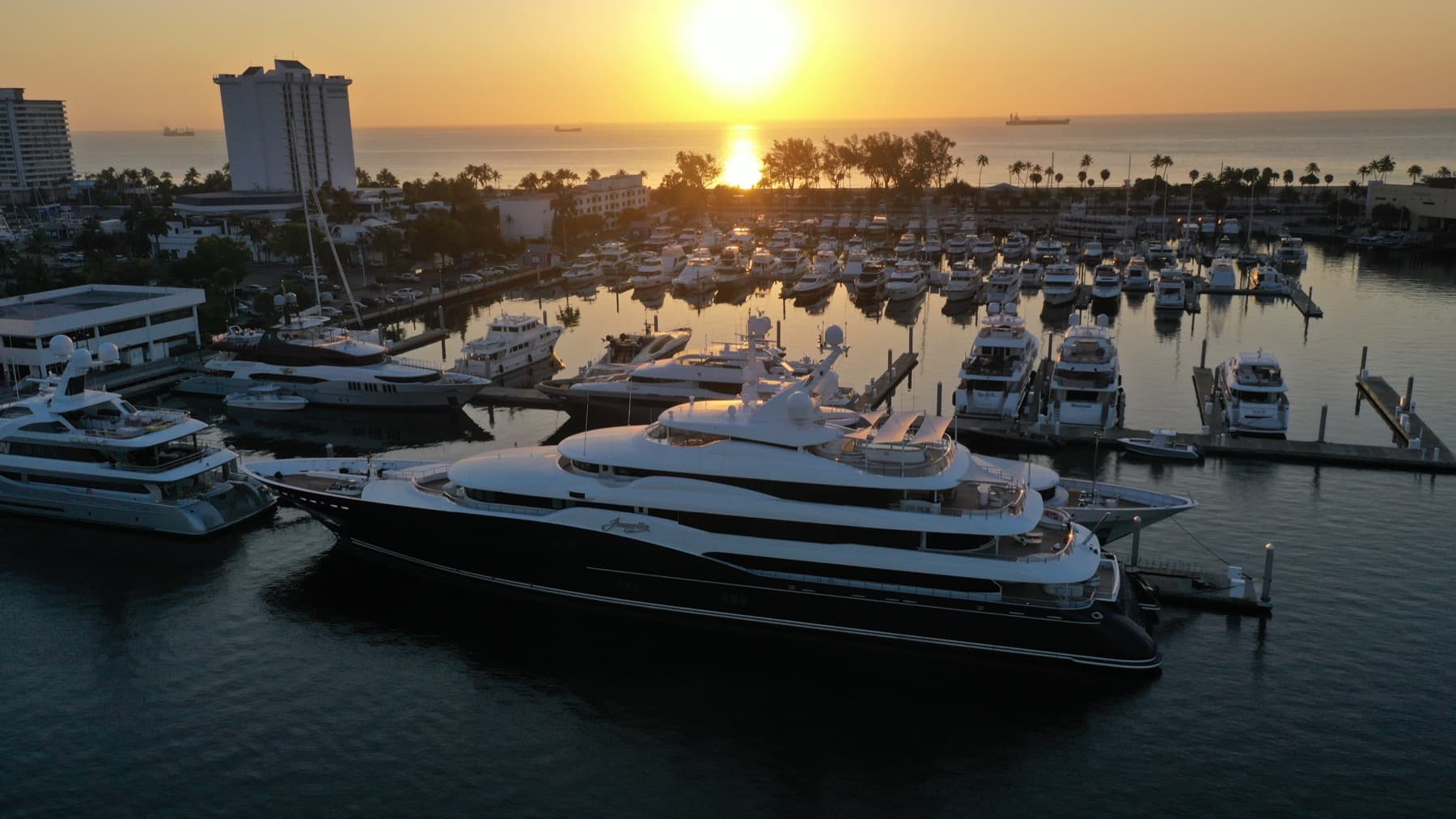
What She Costs to Keep
Ten per cent of her value a year is the working rule, and it is close enough to budget from. Here is what sits inside it in South Florida. Every line, at what rate, and three boats added up.
Line by line
Where the Money Goes
South Florida rates, for a boat kept in a marina and used normally. Fuel is the only line you really control; the rest arrive whether you run her or not.
| What | Typical rate | Worth knowing |
|---|---|---|
| Dockage | $25 to $75 per foot, per month | The biggest line, and the widest. Fort Lauderdale rates vary by marina, location and what comes with the slip; an annual contract beats a monthly rate, and moving a few miles off the prime stretch saves real money. Above roughly 100 feet the per-foot rate itself climbs. |
| Insurance | 1 to 3% of insured value, and up | Driven by the boat's age and condition, your experience, your cruising area and your claims history, and it goes above three per cent readily enough when several of those run against you at once. Named-storm exposure puts South Florida in the upper half to start with. Budget from a quote on your own boat, not from the range. |
| Fuel | By use, not by year | A twin-engine sportfish at cruise burns around 60 gallons an hour, so a full day out is $500 to $1,500 in fuel. A trawler doing the same distance at 9 knots is a fraction of it. This is the line you control. |
| Routine maintenance | $15,000 to $40,000 on a 40 to 60 footer | Bottom paint every 12 to 18 months, engine service intervals, zincs, air conditioning, detailing. Scales with size and with how hard she is used. |
| Hull cleaning | $150 to $400 a visit | Monthly at least in warm Florida water, or growth costs you speed, fuel and eventually running gear. |
| Haul-out and bottom work | By the foot, at every stage | The annual lift for bottom paint and a look at the running gear. Lift, blocking, wash, paint and every lay day are each priced by length with a yard minimum under them, so this line scales with the boat rather than sitting at a flat figure. Book early: slots at short notice cost more. |
| Operating consumables | $5,000 to $15,000 a year | Oil and filters, generator service, watermaker, electronics updates, safety gear in date, and the small supplies nobody budgets for. |
| Captain and crew | $75,000 to $150,000 full-time | A day-rate captain is $400 to $800. Above roughly 70 feet a full-time captain stops being a luxury; above 100, crew need their own accommodation. |
| The repair fund | 2 to 5% of value, per year | Not a maintenance line, a capital one: an engine overhaul, a generator, an electronics refit, structural work. Set it aside whether or not you spend it, because the year you need it you need all of it. |
Added up
Three Boats, a Year Each
Built from the rates above at their middle rather than their extremes: dockage around $40 a foot a month, insurance at two per cent, maintenance and consumables to size, moderate use. A hard-run boat or a premium slip lands higher.
| Boat | Value | Dockage | Insurance | Running | Crew | A year | Of value |
|---|---|---|---|---|---|---|---|
| 50 ft express | $800,000 | $24,000 | $16,000 | $30,000 | None | $70,000 | 9% |
| 70 ft flybridge | $2,000,000 | $34,000 | $40,000 | $55,000 | $75,000 | $204,000 | 10% |
| 100 ft tri-deck | $6,000,000 | $85,000 | $120,000 | $150,000 | $310,000 | $665,000 | 11% |
Fuel is excluded from these totals because it is entirely a function of use. Add it to your own pattern: a day out on the 70 is $800 to $1,500, and on the 50 rather less.
What moves it
Four Things Worth More Than the Rest
Where she sleeps
The same boat on the New River and at a premium beach marina is a five-figure difference every year. Confirm the slip and its rate before you buy the boat, not after.
How often she runs
Counter-intuitively, a boat that is used regularly costs less to keep than one that sits. Systems that run stay healthy; the expensive failures are on the boats nobody turns over.
Her age, and her last refit
A fifteen-year-old hull with a recent refit, tanks done, generators new, electronics current, can run cheaper than a five-year-old boat on original systems reaching their intervals all at once.
Whether you run her yourself
A captain is the single largest step-change in the budget. Below about 70 feet it is a choice; above it, it stops being one.
Straight answers
The Questions Behind the Budget
Tell us the boat you are looking at and we will price her running costs against what owners of that model actually spend, before you commit to her.
(954) 560-2811Is the ten per cent rule accurate?
As a planning figure, yes, and it is the right place to start. In practice it moves with size: under 50 feet without crew, six to eight per cent of value a year is normal; between 50 and 90 feet it sits close to ten; above 100 feet with full-time crew it runs twelve to fifteen. The rule breaks most often on a boat bought cheap. The costs follow the boat's size and systems, not what you paid for her.
What is the single biggest cost?
Dockage, for almost every owner without crew. In Fort Lauderdale it runs $25 to $75 per linear foot per month, so a 50 footer is $15,000 to $45,000 a year on the slip alone before anything else. Once you employ a full-time captain, crew overtakes it.
How much should I keep in reserve?
Two to five per cent of the boat's value a year, set aside as a capital fund rather than a maintenance budget, and ten to fifteen per cent of the purchase price held back for the first season, which is when you find what the survey did not. Owners who spend the last dollar on the boat itself are the ones who end up unhappy with her.
Does a bigger boat cost proportionally more?
More than proportionally, because of the thresholds rather than the feet. Dockage is per foot and the rate itself climbs at the top end. A captain arrives around 70 feet, crew accommodation around 100, and commercial coding regimes above 79 feet if she is ever chartered. Between those points cost rises gently; across them it steps.
Can I offset any of it by chartering?
Sometimes, and it is rarely the free money it looks like. Charter brings a management company, commercial-grade insurance, coding requirements, crew, and wear that shortens every maintenance interval on the boat. It can cover a meaningful share of running costs on the right yacht in the right programme; it does not make ownership free, and it changes how you can use her yourself.
Budgeting for a Particular Boat?
Send us the listing. We will tell you what that model actually costs to run, what her systems are due, and whether the asking price leaves room for the first season’s list.