
Keeping Her, in This Climate
Warm water grows fouling in weeks, the sun destroys anything soft, salt air eats every connection, and the rainy season runs your bilge pumps daily. Here is the calendar that answers all four, and what it costs here.
The calendar
What Falls Due, and When
Nothing here is dramatic in any given week, which is exactly why boats degrade quietly under owners who mean to get round to it.
| Task | How often | Cost here | Why it matters in Florida |
|---|---|---|---|
| Bottom cleaning by diver | Every 2 to 4 weeks | $4.80 to $6.50 per foot | Warm water grows barnacles and algae fast, and growth costs speed, fuel and eventually running gear. This is the interval most owners let slip and the one that costs most to let slip. |
| Exterior wash | Weekly to fortnightly | $4.40 to $6.67 per foot | Salt left on the boat is salt working into fittings, canvas and gelcoat. |
| Check bilge pumps and float switches | Weekly | Varies | In the rainy season they work daily. A stuck float switch during a storm alongside is how boats are lost at their own dock. |
| Electrical connections and battery terminals | Quarterly | Varies | Salt air corrodes connections faster than anything else here. Clean them, then dielectric grease. |
| Marine wax on gelcoat | Three times a year | Varies | Twice a year is the general advice and it is not enough in this sun, three is John's own recommendation for South Florida. Once gelcoat has chalked, waxing will not bring it back; only compounding will, and that is a paid job rather than an afternoon. A ceramic coating is the alternative to the whole cycle, see the row below. |
| Ceramic coating, instead of waxing | Every 1 to 3 years | More up front | The other way to do the same job. It costs considerably more to apply, it is a professional job with real preparation behind it, not an afternoon, but it holds for a year or more rather than a few months, sheds salt and dirt so washdowns are quicker, and stands up to this sun harder than wax does. Over three or four years the arithmetic often comes out level or better; over one season it does not. Get the prep right, because a coating locks in whatever is underneath it. |
| Teak clean and seal | As needed, gently | Varies | Proper teak cleaner and oil or sealer. Never pressure wash it: that strips the soft grain and takes years off the deck. |
| Canvas, upholstery and isinglass | Quarterly | Varies | Marine fabric cleaner and UV protectant. Never fold isinglass warm, and only clean it with products made for clear vinyl or it hazes permanently. |
| Engine service to the manufacturer's schedule | By hours, or annually | Varies | Whichever falls first. Manufacturers specify an hour interval and an annual one, and on a boat that does not run many hours it is the calendar that comes due. Oil left sitting in a sump all season is doing no good. Oil, filters, impellers, belts. Fuel polishing on diesels matters more here than in cooler climates, because humidity puts water in tanks and algae follows. |
| Air conditioning | Serviced twice a year, screens monthly | Varies | Twice, not once: the units run most of the year here and work against heat and humidity the whole time, so the annual interval that suits a northern boat leaves a Florida one short. Between services, clean the intake blower screens every month. They block with dust and salt, the unit loses airflow, and the compressor is what pays for it. |
| Watermaker: run her or flush her | Weekly | Varies | A membrane left wet and idle starts growing within days, and a fouled membrane is a replacement rather than a service. Either make water every week or run the fresh-water flush. Pickling is for lay-up, not for a boat in use. |
| Generator | By hours, or annually | Varies | Its own schedule, and a shorter one than the mains: a generator on a boat living on the hook or running air conditioning at anchor puts on hours faster than the engines do. Hour interval or the manufacturer's annual service, whichever comes first, and run her under load rather than letting her idle, which is what glazes bores. |
| Fin stabilisers | Annually, and at haul-out | Varies | Hydraulic: seals, fluid, hoses and actuators to the maker's schedule, with the shaft seals and fin bearings looked at while she is on the hard. A leak here is expensive and it is below the waterline, so the annual inspection is worth doing even on a boat that has not made the hours. |
| Gyro stabiliser | To the maker's hour schedule | Varies | A different machine entirely and a different interval. The flywheel bearings, the vacuum system and the seawater cooling circuit are the scheduled items, and it is dealer work rather than yard work. Do not assume the boat's general service covers it; ask for the gyro's own log. |
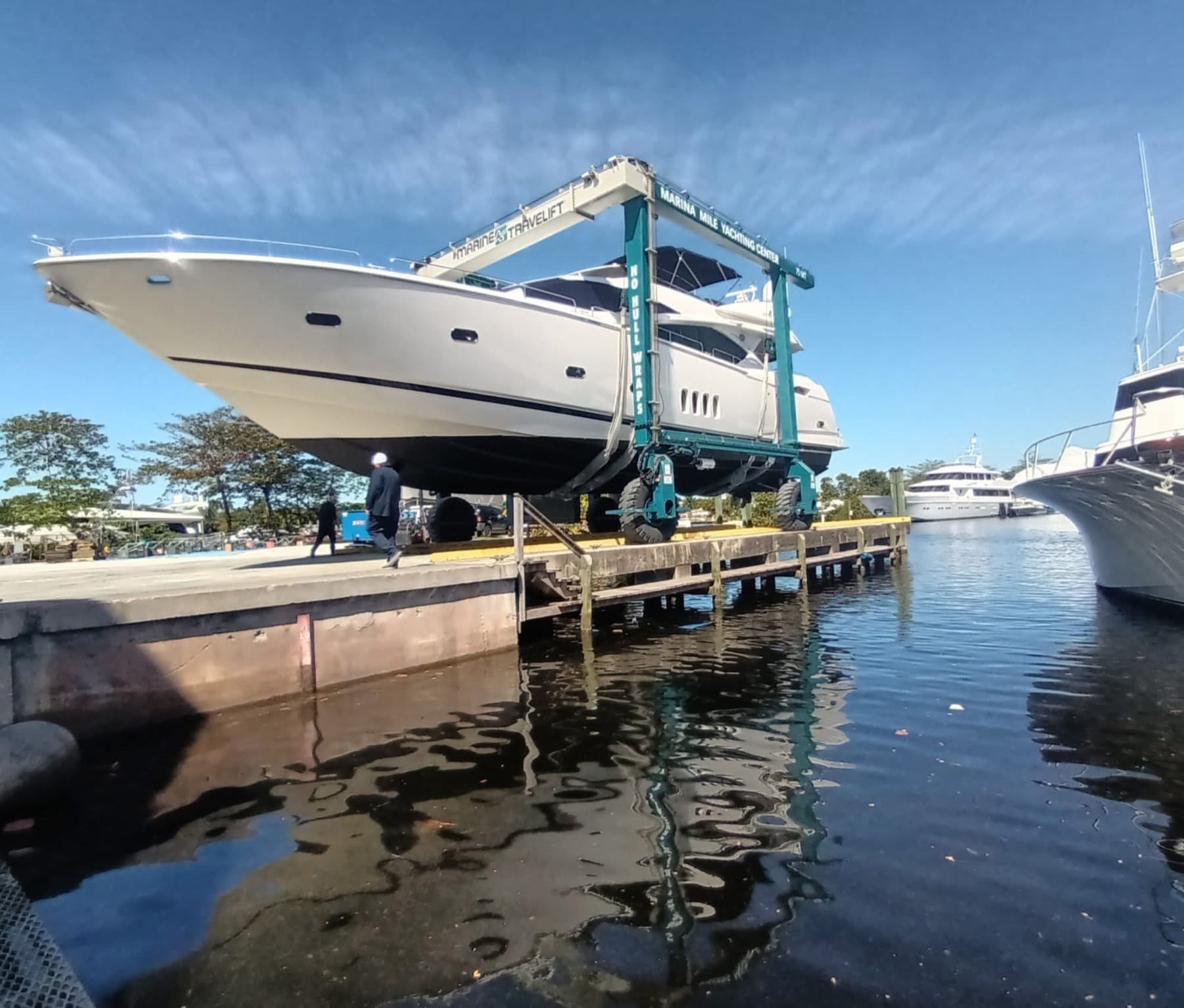
| Haul-out and bottom paint | Annually, or every 18 months | By the foot, at every stage | There is no flat price for this: the lift, the blocking, the pressure wash, the paint and every lay day she spends on the hard are each charged by length, and most yards set a minimum under all of it. A 35 footer and a 90 footer are not the same job at a different discount. Ablative paints suit Florida because they keep releasing biocide as she moves, and the autumn slot is the one to book. The yards are quieter and the pricing is better. |
The other half
Write Every Bit of It Down
Doing the work is half the job. Being able to prove it is the other half, and it is the half that costs nothing.
A surveyor credits what is documented and a buyer deducts for everything else. Two boats can have had identical care and be worth meaningfully different money on the same afternoon, because one owner kept the folder and the other remembers roughly when the generator was done.
Keep it as you go rather than assembling it the month you list, a reconstructed log reads as one, and the invoices you cannot find are the expensive ones. Back it up off the boat, and hand it over at the sale: it is part of what the buyer is paying for.
What belongs in the folder
- Every invoice, dated, with who did the work and what was replaced
- Engine and generator hours read and written down at each service
- Oil and coolant analysis reports, kept in sequence so the trend is visible
- Haul-out dates, the bottom paint product and how many coats
- Warranty claims and their outcomes, particularly in the first two years
- Refit scope, change orders and the weekly photographs
- Every survey she has had, including insurance surveys
- Manuals, schematics and the spares inventory
Before 1 June
Your Insurer Requires One of These Two
This is a condition of the cover, not a way to lower the premium. Through hurricane season a Florida policy will require either that the yacht is out of the named-storm zone and into the latitudes the underwriter accepts, or that you have a written hurricane plan they have approved. An owner who has arranged neither can find they are uninsured at the one moment it matters.
Take her out of the zone
Move her north or south into the latitudes your policy names as acceptable for the season, and she sits outside the named-storm exposure entirely. The boundary and the dates are written into the cover. They vary by underwriter, so read yours rather than assuming the usual line.
- Confirm the exact latitudes and dates your policy names
- Book the passage or the transport early, everyone moves at once
- Check the navigational limits cover the delivery route itself
- Arrange somewhere for her to be, and someone to look at her there
Keep her here, on an approved plan
Stay in Florida with a written hurricane plan the insurer has accepted: where she goes, who moves her, by when, and what happens if you are not in the state. Most owners take this route, and the marina space is the part that runs out first.
- Confirm the haul-out or safe-harbour arrangement in writing, before 1 June
- Name a second choice, in case the first is full or unreachable
- Agree who moves her, and by what hour, if you are not in Florida
- Inventory dock lines, chafe gear, fenders and spares now, not in July
- Photograph her condition inside and out, and store it off the boat
- Send the plan to the underwriter and keep their acceptance
Whichever you choose, read the named-storm deductible and the navigational limits while you are in the policy. both are covered here, and the deductible is usually far larger than owners expect.
Straight answers
What Owners Ask
The divers, mechanics and yards we put owners on to are listed on the survey guide. Nobody pays to be on that list.
Surveyors and yards →(954) 560-2811How often does a boat need cleaning in Florida?
The bottom every two to four weeks by a diver, at roughly $4.80 to $6.50 a foot, and the topsides weekly or fortnightly at $4.40 to $6.67 a foot. Warm water is the reason: growth that would take a season in the north takes weeks here, and it costs you speed and fuel long before it becomes visible.
When should I haul out?
Annually, or every eighteen months depending on the paint system, and in the autumn if you can choose, when the yards are quieter and the pricing is better. There is no flat cost to quote: the lift, the blocking, the wash, the paint and each lay day are all charged by the foot, with a yard minimum underneath. Get a written quote for your own length that separates the haul from the paint from the lay days, because that is where the estimates differ.
What does this climate do that others do not?
Four things, all of them constant: warm water grows fouling in weeks, ultraviolet destroys canvas, isinglass and unprotected gelcoat, salt air corrodes every electrical connection on the boat, and the rainy season runs your bilge pumps daily. None of them is dramatic on any given week, which is exactly why boats here degrade quietly between owners who mean to get round to it.
When should I start preparing for hurricane season?
Before 1 June, and start with the policy rather than the boat. Your insurer will require one of two things through the season: that she is out of the named-storm zone and into the latitudes they name, or that you have a written hurricane plan they have approved. It is a condition of cover, not a discount. If you are staying, the haul-out or safe-harbour arrangement is the part that runs out first, because many Fort Lauderdale marinas run waiting lists and the spaces are gone before the first storm is named.
Is a management company worth it?
For an owner who is not in Florida year-round, usually yes. The failures that cost real money here are the ones nobody noticed for six weeks, and a management programme is essentially somebody noticing. For an owner on the dock most weekends, a good diver, a good mechanic and a written calendar do the same job for less.
Does any of this actually show up at resale?
It is the single biggest thing that does. Deferred maintenance is the largest destroyer of value in this market. A surveyor identifies it in an afternoon and the discount that follows always exceeds what was saved by skipping the service. The other half is the record: work you cannot evidence is work the next surveyor will not credit.
Thinking of Selling Her Next Season?
Start the record now. Deferred maintenance is the largest destroyer of value in this market, and the folder that proves the work is worth a real share of what the work cost.