
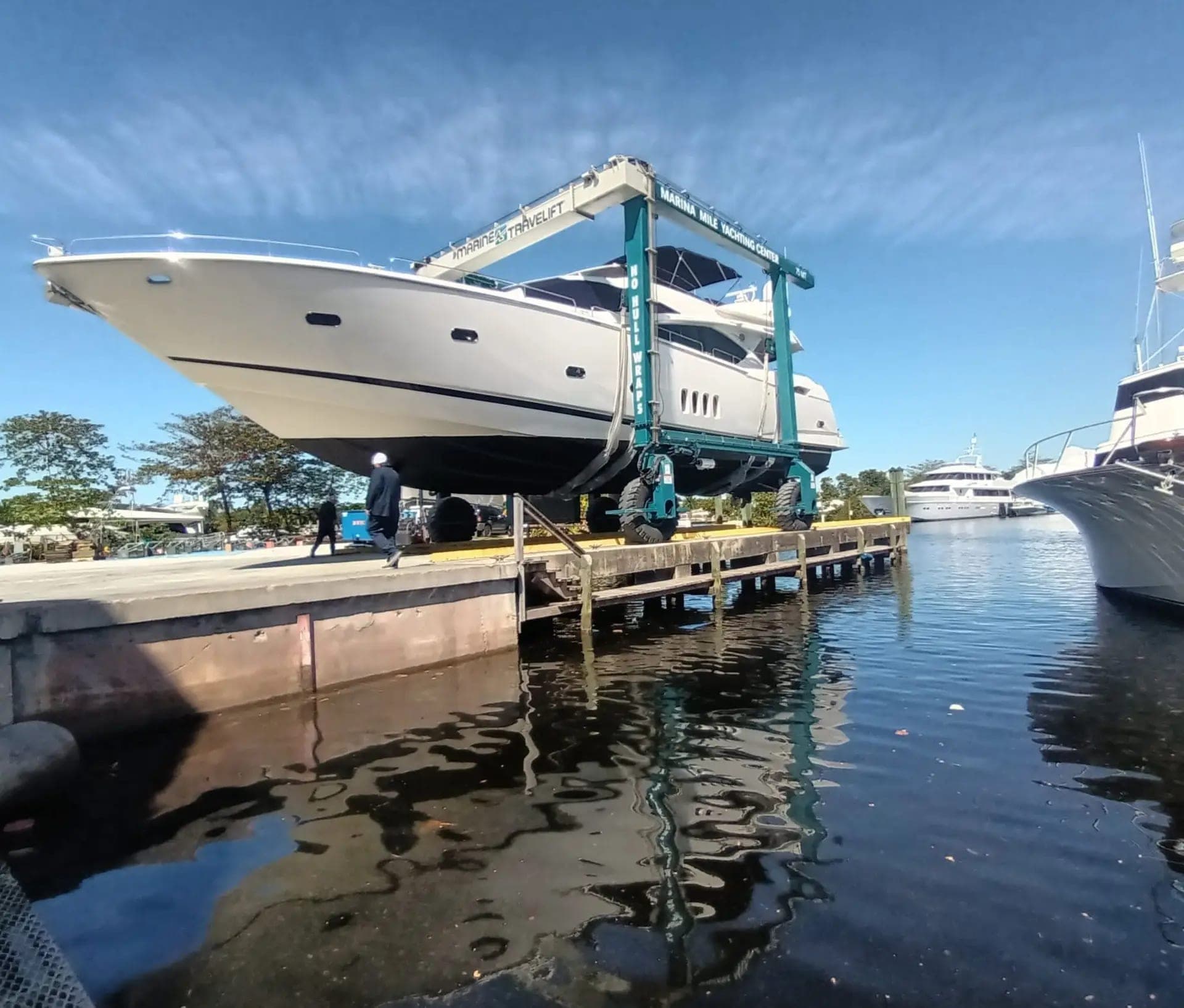
Refit Her, or Sell Her
That is the decision underneath every refit, and it turns on cost against what comes back. Here is what each job costs, how long the yard needs, and how much of it you see again at resale.
Four kinds of work
What Each One Costs You
The last column is the honest one. Most refit work does not return its cost dollar for dollar. What it does is change how fast she sells and how firm you can be on price.
| The job | Cost | In the yard | Back at resale | What it covers |
|---|---|---|---|---|
| Cosmetic refresh | 5 to 15% of value | 2 to 6 weeks | Most of it | Upholstery, carpet, headliner, countertops, LED lighting, gelcoat or paint, canvas and enclosures. The highest return of any category, and the one to do before listing rather than after. |
| Electronics and navigation | $15,000 to $75,000 on a 40 to 65 footer | 1 to 3 weeks | Some | Multifunction displays, broadband radar, AIS, satellite comms, integrated autopilot. Removes a deduction a buyer is already making; rarely adds its full cost to the price. |
| Mechanical overhaul | By engine and hours | 3 to 10 weeks | Only if documented | Mains, generators, air conditioning, watermakers, hydraulics. A top-end overhaul costs far less than replacement and restores near-new performance, but only counts at resale if the paperwork proves it. |
| Structural and hull | By survey | Varies widely | Not directly | Hull repair, stringers and transom, rebedding deck hardware, through-hulls, rudders and running gear. Invisible work that does not raise the price, but its absence takes a boat off the market entirely. |
When, not whether
The Hours That Decide It
5,000 to 8,000 hours
Where diesel main engines typically come due for overhaul, depending on the manufacturer and how well they were serviced. A top-end is a fraction of a repower and buys most of the performance back.
Generators, sooner
They run more hours than the mains on most boats and follow the same pattern at lower intervals. A tired generator is one of the most common survey findings that turns into a price adjustment.
Air conditioning
A modern variable-speed system draws 30 to 50 per cent less than an older fixed-speed one. On a boat that lives on shore power in Florida that is a running-cost change, not just a comfort one.
Watermakers
Current units make more water on less power and break down less. Worth doing at the point the old one starts needing attention rather than nursing it another season.
Running the project
Six Habits That Keep It Near Budget
Hire a project manager for your boat
One person whose job is your refit and nobody else's, scope, change orders, schedule, and the yard held to all three. Without one the role falls to you, weekly, in person, and it is the difference between a project that lands near budget and one that quietly does not. They should report to you weekly with photographs.
Write the scope before you ring a yard
A clear written scope is what makes three quotes comparable. Without one you are choosing between three different jobs at three different prices and calling it a comparison.
Get two or three detailed estimates
South Florida has an unusual concentration of world-class refit yards, Fort Lauderdale, Dania Beach, Hollywood and Riviera Beach, so there is no reason to take the first number.
Budget 10 to 20 per cent over
Refits find things. Opening a boat up reveals what the survey could not reach, and the overrun is close to universal. Build the contingency in at the start and it is a plan; discover it in week four and it is a crisis.
Insist on a change-order process
Every addition to scope in writing, priced, before it is done. This one habit is the difference between a refit that lands near budget and one that does not.
Keep every invoice
A refit you cannot evidence is a refit the next surveyor will not credit. The folder is worth a meaningful part of what the work cost.
The yardsWe keep a working list of the yards we put owners on to, alongside the surveyors, on the survey guide. Nobody pays to be on it and we take no fee from any of them, which is the only reason a recommendation is worth having.
Straight answers
Refit or Move On
We are brokers, not engineers, so what we can tell you is the market half: what a boat in that condition is worth today, what she would be worth with the work done, and how each version would sell. What the job involves and what it should cost is for a project manager and the yards, and we will put you in front of both.
(954) 560-2811Is it cheaper to refit or to buy a newer boat?
On a sound hull from a good yard, refitting is very often the cheaper route to the same capability. You are buying the systems rather than the structure, and the structure is the expensive part of a new build. The calculation changes if she needs structural work, if the layout is wrong for you, or if the model is one the market has moved past. Get a survey first and price the actual list; the decision is usually obvious once the list exists.
Which refit returns the most at resale?
Cosmetic, by a distance, and it is also the cheapest and quickest. New upholstery, canvas, headliner and a tidy gelcoat change how a boat shows in photographs and aboard, and presentation is what sells. Electronics come next. Mechanical and structural work rarely returns its cost as price. What it does is make her sellable at all, and let you hold your number when the survey comes back.
How long will the yard have her?
A cosmetic refresh is two to six weeks. Electronics one to three. A mechanical overhaul three to ten depending on what comes out. Structural work is the one that genuinely cannot be predicted, because the scope grows as the boat is opened up. Whatever you are told, add the contingency to the calendar as well as to the budget.
Should I refit before selling?
Do the cosmetic work, yes. It pays, and it is the difference between a boat that shows well in the first fortnight of a listing and one that does not. Do not start a mechanical or structural project on a boat you have decided to sell: you will spend the money, the market will not return it, and the boat sits on the hard while her days on market climb. Tell us what she needs and we will say which side of that line it falls.
Who manages the project?
Hire a project manager dedicated to your vessel. It is the first decision, not the last: one person whose job is your boat and nobody else's, holding the yard to the scope, pricing every change order before it is done, and reporting to you weekly with photographs. Without one, the role is yours, and it is a job. On a straightforward cosmetic refresh a good yard and a clear written scope can be enough, but the change-order discipline still applies.